
Welcome!
If you have ever parked outside a gym, stared at the front door, and thought about driving away, this blog is for you.
Starting at the gym can feel intimidating. The machines look confusing, everyone else seems like they know what they are doing, and it can feel like people are watching you even when they probably are not. I know that feeling because I used to look the part, but was self-conscious about where I worked out. I wanted to get stronger, but I did not want to walk into a gym where I knew everyone and still felt completely out of place. That is the trickiest thing about working out. The one thing that can get you where you want to be is the hardest part: just getting started. Once you actually walk through the door, it slowly gets easier. You learn a few machines, figure out what workouts make sense for you, and realize most people are focused on themselves. Everyone at the gym started somewhere, even the people who look like they have it all figured out. Eventually, one rep at a time you’ll get it. It just takes time. This blog is about starting small, building confidence, and not comparing yourself to everyone else. You do not have to be perfect on day one. You just have to show up, do the work, and keep going. The gym does not have to feel like a chore. Over time, it can become something you actually look forward to.
So grab your ID card, commit to a routine, and walk in even if it feels awkward. That first step is the hardest one, but it is worth it.
May 16:What it Looked like for Me
As a freshman and sophomore in sports, age and size are very obvious. You notice it every day. You can be tall and skilled, but it is rare that you will have the size and strength of the juniors and seniors. The older players have put on muscle, move stronger, and lift more. When you are younger, it is easy to feel like you are behind before you even start.

The answer seems simple: go to team workouts, go to the gym, and get stronger. That is the answer, but it is not always that easy.
I had the desire and was willing to put in the time. The hard part was actually walking into the gym and feeling like I belonged there. I knew a few things from team workouts, but not enough to feel like I fully knew what I was doing. I could do some lifts, but I still felt unsure. My head kept telling me that everyone was watching.
That was probably the biggest problem. My body looked the part in some ways, but I was still young and new to lifting. I was not putting up a lot of weight, and I felt self-conscious about it. Everywhere I looked, there seemed to be someone in great shape, lifting a lot of weight, and acting like they had been there forever. My head kept telling me they were all watching.
The reality was different. Nobody was really watching.
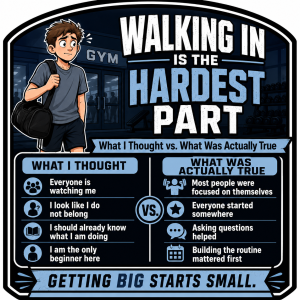
Most people were focused on themselves, their own workouts, their own music, and their own goals. I also realized that my anxiety had me paying attention to the fittest and most confident people in the gym. I was comparing myself to the people who stood out the most. But most people there were a lot more like me than I thought. They were just trying to get better too.
Over time, I started talking to people and asking for advice. That helped more than I expected. Not only did I get better tips, but I also realized that people were usually happy to help. A lot of them had probably felt the same way when they started. They were not judging me. They were just farther along.
I also learned that progress takes time, especially when you are younger. At 15 or 16, you might not see huge changes right away. Your body is still growing, and sometimes the biggest thing you can build is the routine. For a while, the progress felt small. Injuries also set me back, which made it frustrating. But once I got more consistent, things started to change. I got more comfortable, learned more, and slowly started making progress.
At first, going to the gym was about getting stronger for sports and looking better. But after a while, it became more than that. I started liking the routine. I liked talking to people and learning from them. I liked hearing about their goals and what got them started. I also liked how working out made me feel, not just physically, but mentally too.
Walking in really is the hardest part. Once you do that, everything else starts to feel a little more possible.
May 22: You Don’t Have to Know Everything
Figuring Out What to Do Once You’re There
Walking into the gym is the hardest part, but it is not the only hard part. Once you’re inside, you’ll need to figure out what to do.
That was the part I struggled with at first. I knew a few things from team workouts, but due to injuries, I hadn’t learned as much as I wanted to, and a lot of those exercises didn’t work for me. I definitely didn’t feel like I knew my way around the gym. There is a big difference between knowing a few lifts and feeling confident enough to build your own workout. At first, I mostly stuck with machines because they were easier to figure out. The fly machine, leg press, and bicep curl machine were all less intimidating than walking over to the free weights and trying to act like I knew what I was doing. That was also the area where my lack of strength felt more obvious because the more experienced lifters spent most of their time there.
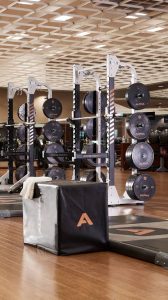
Starting with machines helped because it gave me a place to begin. I did not have to create the perfect workout right away. I just needed to start trying things and most of the machines have instructions on them. Some exercises worked, and some did not. The only real free weights I did at the start were squats and RDLs, which I had learned in team workouts. Even though RDLs are popular, I dropped them early on because they felt awkward to me. That was a big lesson for me. You do not have to copy someone else’s workout. You have to find what works for you.
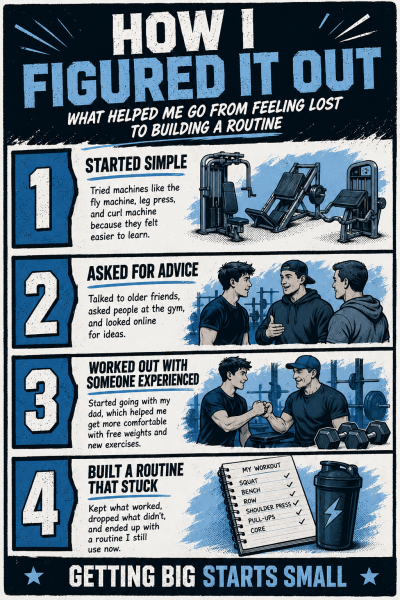
I also started asking for advice. I asked older friends, especially an older friend named Cole, and other people at the gym who looked like they knew what they were doing. I also followed a few people on TikTok to get ideas, but I learned pretty quickly that not everything online is perfect for you. The best advice I got was that the exact exercises do not matter as much as being consistent. People also told me that it’s a good idea to swap exercises every once in a while, even if you like what you are doing, because your body gets used to the same routine.
After I had been working out for a while and built a better base, I asked my dad to start going with me. He had worked out consistently for a long time, so he helped me get more comfortable with free weights and exercises that the older kids and more experienced people were doing. We went together for a couple of months, and that helped me really dial in a routine. I still use a version of that routine now.
The point is that you do not need to know everything on day one. Start simple, ask questions, try different things, and keep what works. The initial goal is just to start building a routine and a foundation. You won’t see much progress right away, because your body is just learning the motions, but if you go consistently things will eventually start to kick in. Eventually, the gym starts to feel less confusing and more like part of your routine.
May 28: What Changes When You Keep Showing Up
It’s Not Just About Getting Bigger
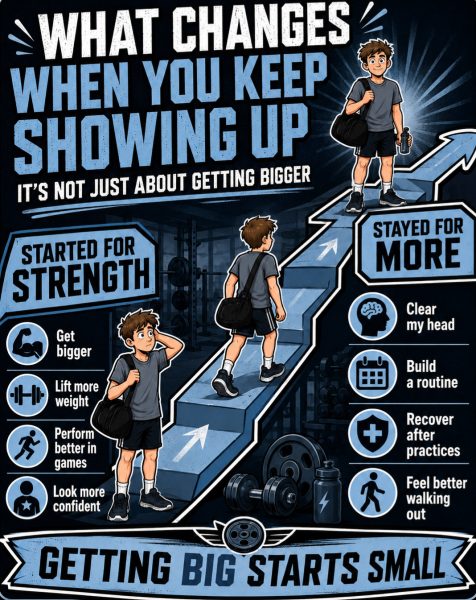
When I first started going to the gym, I mostly cared about lifting more weight and looking stronger. That is probably why a lot of people start. You want to get bigger, feel stronger, and see some kind of progress. I still care about that, but after going for a while, I realized the gym became about more than just getting bigger.
One of the biggest changes was that the gym started feeling normal. At first, I felt like I had to think about everything. What machine should I use? Am I doing this right? Do I look like I know what I am doing? After a while, that started to go away. I built a routine that worked for me, and I stopped walking in feeling completely lost.
My schedule changes depending on school, sports, and everything else going on, but I still try to go consistently, usually five or six times a week. I have a rotation I like, with days for chest and shoulders, back, legs, and arms. It is not some perfect professional routine, but it works for me. That is what matters. Once you have a plan, the gym feels a lot less intimidating.
The physical results also started to come with time. They were not instant, and that can be frustrating. You can go for a while and feel like nothing is happening. But if you keep showing up, learning, and putting in the work, things start to change. You get stronger, you move better, and you start feeling more confident.
The part I did not expect was how much the gym would help mentally. After a long school day, practice, or just a stressful day in general, the gym gives me somewhere to reset. Most of the time, I leave feeling calmer and more productive than when I walked in. It also helps with recovery after games and practices. Sometimes it is not about going as hard as possible. Sometimes it is about moving, getting a good workout in, and feeling better afterward.

If I was talking to someone just starting, I would tell them it is fine to want the physical results. That is what gets a lot of people through the door. But if you stick with it, the gym can become more than that. It can become part of your routine, a way to clear your head, and something that builds confidence over time. You do not need to have everything figured out. Just keep showing up.