Welcome to Garb. I am your host, Grace Reger. Come with me as I travel behind the scenes and learn how costumes are designed. So much time and thought go into each piece, which is crazy, considering the audience will only see the garment for a split second on stage. I have always been intrigued by the world of fashion, the glamour, the sparkles, the beauty, I mean, how could anyone not be intrigued? I’ve been involved with theater for almost ten years now, so I’m practically an expert on theater costumes. I’m just kidding, but I do want to share some interesting stories and facts with you. So, if you’re interested in fashion or theater, or just want to have a good time, this blog is for you. I am beyond excited to share my findings with you all, and I hope you have as much fun as I have with a world that creates new stories with deeper meaning.
May 22nd, 2026: Corsets, Crinolines, and Characters – The Evolution of Theater Attire
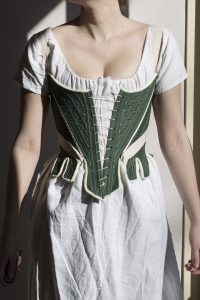
It is well known that at the beginning of the theater, pretty much the entire cast was made up of men. This was because society viewed the profession as deeply immoral and immodest. That’s not to say women didn’t participate, but if/when they did, they were cast off from society. Personally, if I were alive during this time period, I’d still try to act; maybe I could dress up like a man and fool all of them. Anyways, back to the beginning of theater attire. If the director wanted a female character, a man would have to dress in drag. The men playing female roles were laced into stiff, heavily boned undergarments known as stays (an early version of the corset). To create the full shape, the corsets were worn alongside structural undergarments like farthingales (hoop skirts) and multiple heavy petticoats. I’m sure this showed them how annoying women’s clothing was at the time. Theater companies would find cast-off clothing from the wealthy nobles so that their actors could look of higher status. Because of this, the characters’ undergarments and outer dresses were very accurate to real, everyday noble fashion. Even though corsets are famously associated with women throughout the decades, they were considered essential theatrical equipment to transform the male actors.
After years and years of men performing in drag, women were finally allowed to enter the theater in 17th-century Europe. Without the need to hide the masculine frame and changing voices of male actors, costumers could create authentic, eye-catching women’s silhouettes. Actresses were styled in deep décolletages, cinched corsets, and heavy voluminous skirts. Before the restoration, Elizabethan theatrical companies continued to use the hand-me-down noble clothing that men wore years before. However, actresses demanded the latest trends, making the stage a place for the most cutting-edge fashion. If someone wanted to see something new in the fashion world, the theater was the place to go. Designers no longer trying to force femininity onto the male physique were able to highlight femininity in real women. Actresses used stage lighting with shimmering additions like sequins and iridescent fabrics. Headpieces, veils, fans, and elaborate makeup to emphasize their features were a must.
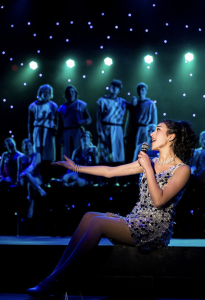
This all still stands true to today’s standards of theater. It’s no surprise that people like a little shine and a little dazzle here and there. So when the actors come out dressed to the nines in sequins and gems, who wouldn’t have a blast? The addition of women being allowed in the theater created a great growth in the fashion industry and allowed designers to create the garments they wanted to produce in the first place.
In earlier eras, actors wore huge, lavish garments to make it seem like they had a high social status (as previously stated). Today, designers think of costumes more as tools to help define a character’s journey, personality, and emotional state. Modern musicals have shifted to a more fast-paced story because of society’s attention status becoming shorter, making quick changes much faster. And trust me, sometimes the quick changes are too quick. One time I had a fifteen-second quick change to change outfits completely, put on a new wig, glasses, shoes, a belt, and a purse. When I tell you, I waddled out on stage holding up my belt as my wig fell in front of my eyes, I’m not kidding. It was quite the moment.
Costume designers have added velcro, snaps, magnets, and even reversible panels to make a ten-second costume change feel effortless. With the new way musicals are performed, the fabric has to change with it. Designers now use lightweight, flexible fabrics to allow the actors to perform more complex choreography without restriction. Some modern productions even break traditional historical rules. Take Hamilton, for example, 18th-century silhouettes with modern footwear and streetwear. It combines the older, more traditional style of theater while adding a relevant twist to help the audience feel more connected to the story.
If you ever find yourself at a new production of a musical, look at the costumes and try to see how history has passed down tradition. Or better yet, look for someone who’s just messed up a quick change as they come out tripping over their dress.
May 25th, 2026: Into the Wardrobe
I am a firm believer that Into the Woods is one of the best musicals for costume design. The amount of creative liberties the costume designer can take is absolutely crazy. For those of you who don’t know much about the plot of Into the Woods, I’ll provide a brief description real quick. Basically, there are the Baker and the Baker’s wife (they don’t have real names), and they are neighbors of a witch. The Bakers want to have a baby, but learn from a catchy tune that the witch cursed the Baker’s family tree to be barren because his father stole beans from the witch’s yard. Cinderella is introduced, along with Jack from Jack and the Beanstalk, Little Red Riding Hood, and Rapunzel. All of these characters go into the woods, and chaos ensues. There are many more details I’m missing, but let’s get back to the costumes.
Because all the characters are based on separate fairy tales that are combined, the costume designer can create whatever costumes they want. I’ve always found this beyond fascinating. Every time I watch a performance of Into the Woods, I look for the specific choices the designer made regarding each individual character. Today I would like to share with you what I would choose for some of the costumes.
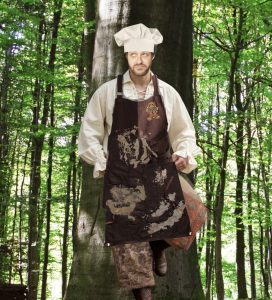

To begin: The Bakers. They are the only characters not from a specific fairytale. However, in my mind, they are the bakers who create the gingerbread man from The Gingerbread Man. So, if I were to design their costumes, I would keep them in their typical attire seen in most adaptations, but the fabric would be made up of old tapestries and rugs sewn together. Little details from each fairytale sewn on to show how they are moving the plot along, and more specifically, on their aprons, I would put an embroidered patch of a gingerbread man in a corner to have my own little version of the story. The Baker’s Wife would have her hair up in a messy bun and a headband made from a torn-up scarf to keep her hair out of her face. As she’s going through the woods, she would use her scarf/headband to heal wounds and hold props.
Next up: The Witch. If I were to design her costume, I would want her beginning look to be extremely chaotic. Fringe galore, with thick fabrics that don’t flow very pretty but move rigidly. A hood made of an iridescent brownish-green cloaks her face during her first song. When she takes her hood off, her makeup is laid thickly upon her face (it’s cakey and there’s too much going on). I would want her to have black lacy sleeves that go to a point on her hands, and the tips of her fingers would be painted in a fading dark black towards her forearms. Once the curse is broken and her transformation makes her beautiful again, I don’t want to change the color scheme of her character as they do in most versions. I want her to stay in her deep natural colors, but have it look more like she is one with nature. Her hair would be long and slightly wavy, her dress made of flowy brownish-green iridescent fabrics, but her black lacy arms would stay the same. Her makeup is simple and natural because she now feels beautiful enough that she doesn’t feel the need to hide her face.
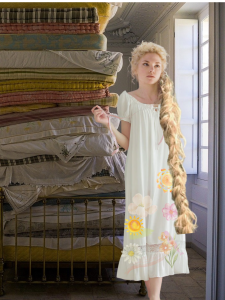
Lastly: Rapunzel. In my version of Into the Woods, Rapunzel would double as herself and the princess from The Princess and the Pea. Are these characters completely different? Yes. But it’s my version of the show, so it is what I make it. She would be seen wearing a white nightgown that’s long with ruffles at the bottom and short, poofy sleeves at the top. Her simple nightgown is hand-painted with her own designs, mostly suns and flowers (basically what she can see from her tower). Her golden hair is braided into three braids, and those braids are braided together, if that makes sense. She has very peachy makeup to emphasize her natural beauty. Now, instead of having a tower on stage, I would ask the set department to make a stack of mattresses with a big pea at the bottom to pay a homage to one of my most beloved fairytales, The Princess and the Pea. The lines from the script all stay the same, but now we have another fairytale embedded into the story.
As much as I would love to explain, in depth, my costume decisions for each character in the musical, I’m going to give you the liberty to finish my designs. I hope my ideas give you a good perspective on the possibilities with costume design, especially regarding Into the Woods. And now, I will leave you with my final message of the day, “The woods are just trees, and the trees are just wood” – Baker’s Wife.
May 28th, 2026: Dressed to Kill – Roxie Hart vs. Velma Kelly

You may be wondering, Grace, what’s the best musical of all time? And my answer, hands down, would be Chicago. Everything about it, from the catchy tunes to the sparkly costumes, intrigues me. The story follows Roxie Hart, a young woman who dreams of being a showgirl, and fading vaudeville star Velma Kelly. Both women are imprisoned for murder and fight to have the slick lawyer Billy Flynn win their case. He turns their trials into media spectacles to manipulate the justice system and chase fame. One of the things I find most interesting about the show is the costumes. Shocking, I know. But the way Roxie and Velma’s wardrobes reflect their opposing personalities is really interesting to me. Obviously, in every rendition of Chicago, the costume designer can tweak specific elements to fit their vision, but for the most part, the basis of the character design for Roxie and Velma remains the same.
Roxie Hart is driven by a desperate desire for fame, romance, and adoration. Her wardrobe reflects this delusion of innocence, even though she truly is guilty. Her costumes lean into a lighter, fluid Art Deco aesthetic. Think drop-waist silhouettes, looser fringe, and softer fabrics that catch the light in a more playful manner. Roxie’s outfits scream “look at me,” but with a flirtatious, wide-eyed innocence that hides her true nature (which is ideal for the show’s plot).
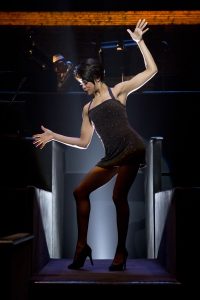
Velma Kelly stands out as a professional who understands how things work. She never pretends to be innocent and always earns respect. Her style is tough, shown through sharp tailoring, strong lines, and practical outfits made for bold, athletic dance moves. Velma’s signature look, with her sleek bob and fitted, armor-like leotard or romper, projects both power and cynicism.
As the show progresses, we see Roxie literally and figuratively steal Velma’s spotlight, a transition I’m charting through three key visual shifts:
1) The Introduction: First we see Velma commanding the stage as she sings the opening number, “All that Jazz,” in her classic dark structured performance outfit. Roxie is introduced in more subdued, domestic attire, a nobody looking in from the outside, like her husband Amos.
2) The Media: As Roxie manipulates the press, her wardrobe transforms as she becomes more popular. She starts wearing sparkly, fringe-heavy flapper dresses. The sparkly light fabrics capture the media’s fickle attention and reflect her newfound status as jazz history’s most glamorous innocent. Meanwhile Velma has become a nobody and is still stuck in prison.
3) The Duet Finale: By the time we reach “Nowadays” and “Hot Honey Rag,” the visual contrast comes to a compromise. The two rivals share the stage in matching, glittering outfits. It is, in my opinion, one of the best visual payoff’s in costume history. Roxie has finally elevated her wardrobe to match Velma’s star status, forcing a truce where they must share the sparkle equally in order to stay famous.
Writing this blog has been such a joy, and I am so grateful to everyone who tuned in to explore the beautiful, chaotic, and sparkly world of costume design with me. Next time you find yourself sitting in a dark theater waiting for the lights to come up, take a closer look at what the actors are wearing. Remember the velcro, the hidden meanings, the hours of design, and yes, even the poor soul backstage currently surviving a fifteen-second quick change.
Thank you for traveling behind the scenes with me. Keep loving fashion, keep supporting the theater, and above all, never be afraid to share your own sparkle with the world.
For the last time… this is Grace Reger, signing off. Take a bow, everyone!