

Superior Storytelling: How Music Inspires Film & Television
A good soundtrack takes a film from halfway decent to forever transformative. Unlike the 30s, music is no longer assigned a prerecorded track; every detail must have a value, otherwise it sounds like a coverup for poor writing and an undetectable message. In response to a question about his score for The Dark Knight in 2008, Hans Zimmer—one of the most influential composers in film—describes this shift in production by saying, “At my best, words will fail you because I’m using my own language.”

Today, filmmakers and TV directors have learned from history, and tap into this sonic power to enhance their work, making it a 45.5 billion dollar industry in 2023. Directors have learned to be unique with soundtrack guidelines, often using irony to convey an idea. In the film Goodfellas, Martin Scorsese uses an upbeat song over a montage of corpses to play with the audience’s emotions and foster an eerie feeling.
Similarly, music can trigger memories and associations. Soft melodies to soothe, fast tempos to incite fear, and deep strings to convey sadness; all of these instrumental choices have a psychological response. These melodies are the reason anyone can recognize the Star Wars intro notes, without ever having seen the film.
The last 20 years have seen an increase in biopics such as Bohemian Rhapsody, Walk the Line, Rocketman, Elvis, Springsteen: Deliver Me From Nowhere, A Complete Unknown, and more. Bohemian Rhapsody grossed 910.8 million dollars and won 3 Oscars, demonstrating audiences’ desire to hear the personal stories of artists they love. In a Bazaar article, pop culture expert Dermot McNamara describes the cause for this phenomenon as “immensely popular because they blend two powerful storytelling elements: music, which evokes deep emotional connections, and the personal struggles behind some of the world’s most iconic artists. These films resonate across generations, offering nostalgia to older audiences while introducing younger viewers to legends they may not have grown up with.”
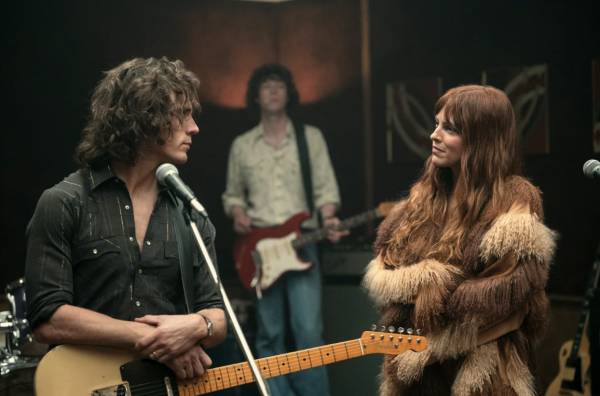
Today, directors create a soundtrack to teach an audience something without directly referencing any real events. Daisy Jones & The Six, is a series that follows a band’s journey to fame. The book by Taylor Jenkins Reid was originally inspired by Fleetwood Mac and other 70s bands, which drives nostalgic familiarity, but the creative twist this show has on music takes it to a new level. The cast actually learned to play their respective instruments for the series. Daisy Jones & the Six exemplifies the modern music in film experience, specifically the connection an audience can form to the characters when directors effectively combine scoring and scripting. The musical influence makes viewers feel personally connected to the characters through improved quality of emotional investment.
Soul is another one of these productions where music and writing intersect. The film hits the audience hard with many philosophical questions, while the main character Joe goes most of the movie convinced his “purpose” is music. This reflective voice produces a wonderful score for the film and an emphasis on jazz throughout. This movie uses elements of relatability, powerful feelings, and strengthening music to make a statement about our current society.
Whether music inspires film and television through an incredible orchestral score, as motivation for a historical retelling, or to convey a message through storytelling, its impact is undeniable. When used effectively, music has the power to highlight the subconscious details words can’t easily express, making it invaluable to some of the best modern productions.
Jazz Done Wright
“Hidden Dimple”, “Oodles of Blues”, “Pickles”, “Empathy.” What do all of these have in common, one might ask? They are all jazz ensemble pieces composed by jazz legend Steve Wright.
Last year, Steve composed a piece for the Minnetonka High School Jazz Ensemble, called “Quotes.” My determined research on Steve started with listening to “Mumbles,” a recording featuring Clark Terry where Steve played lead trumpet. Clark Terry played with Duke Ellington and became one of the first African American studio artists. Clark Terry is just one of the many talented musicians Steve Wright has worked with over the years, and I was excited to uncover so much more.

Steve Wright is a composer, arranger, educator, publisher, and the 4th generation trumpet player in his family. He continued on with jazz after childhood, earning a Bachelor in Music, Master of Music, and Doctor of Musical Arts across the University of Iowa and University of Minnesota programs. His career in music officially began in 1968 as lead trumpet for the United States Air Force-Airmen of Note during the Vietnam War. In 1972 he left to live in the Twin Cities, where he began teaching at Gustavus Adolphus College. He directed private trumpet lessons there. Additionally, he taught many courses such as Jazz Ensemble and Music Arranging, Jazz History, and Music Technology & Careers in Music. Two years later, he formed the Steve Wright Big Band, who went on to play concerts, shows, private parties, and even record an album, Take Two. In 2011, Steve co-hosted the 36th annual international Trumpet Guild Conference, breaking an all time record attendance of 15,000 registrants.
With the leadership of mentors Doc Stevens and Clark Terry, Steve learned to become a role model for others in his life. He is still in touch with many of his students and friends in the industry. When he isn’t getting coffee with them, he is showcasing his big band at weddings, performing “Don’t Get Sassy” with Thad Jones, trumpeting for Rosemary Clooney, composing music for jazz ensembles, playing with Janet Jackson, showcasing his skills in the St. Therese Jazz Quartet, or teaching his 6th generation trumpeter grandson.
To quote Steve, he believes it is important to, “learn as much as you can about every facet of music.” He explained that jazz is about the unpredictable and improvising interactions that make the music memorable. The true jazz fashion is about individuality and relationships with others; a lesson we all can learn from jazz powerhouse, Steve Wright.
Top 10 Ways Music Impacts the Human Experience
- Encourages Focus
Music enhances hyperfocus and hyperattention due to evolutionary adaptations from ancestors. A Harvard Medicine article from Allison Eck explains that early mammals used their sense of hearing for survival, which we as humans have a natural instinct for today that inspires concentration.
- Awakens Emotions
Allison Eck also illustrates the impact of patterns of tension and resolution in music on emotional recognition. The complex processes in the brain are triggered. Our anticipations become fulfilled and violated by unexpected patterns and predictions, thus leading to parallel emotional responses.
- Impacts Therapy and Recovery
It acts as a powerful tool for musical therapeutic solutions to diseases such as Parkinson’s, Alzheimer’s, and depression. Based on research from the National Library of Medicine, identifying types of music sets off an emotional response, which can “improve, heal, or compensate for disrupted brain function in many diseases.”
- Shapes Communication Pathways
Music unfolds in real time, undeniably capturing our attention, acting as an ideal vehicle for the implementation of specific experiences in the brain. According to that same Harvard publication, the neurons will fire in new ways through the brain, regardless of the duration of listening, thus helping to shape communication pathways over time.
(Scarlett Penhollow)
- Crucial to Learning and Acquisition of Musical Skills
Scientists from the National Library of Medicine article on the transformative power of music highlight that repetitive training of musical skills–such as learning an instrument or vocal instruction–fosters cognitive development, motor skill improvement, and mental health benefits. Long term practice leads to fewer neurons needed to perform the action. This means engaging in musical creation can lead to positive mental health and improved creative talent.
- Triggers Memories
According to the same NLM article, the spontaneity and effortlessness of music has the power to “trigger memories, awake emotions and intensify social bonding.” Often, it is easy to recognize how a song reminds a person of a related event, memory including the song, or period of life it precipitates.
- Impacts on Sports
In reading Runner’s World article on music, it is shown that tone and rhythm in music can heighten emotions to the point where it impacts the physical ability of athletes. From pacing in running, encouragement in intense training, or pump-up music before game days, music inspires athletes to create or succeed in their own respective fields of sports.
- Encourages Effective Writing
The article “The Role of Songwriting in Music” shows how music itself offers a source for inspiration and brainstorming. It shapes identity, allowing for a supporting facet of ideation and boosts energy for writing flow.
- Improves Mood
From sound waves, to electric signals, through the auditory nerves to the brainstem, and thus activating cortical areas; the process of sound perception takes many steps. The National Library of Medicine states this intricacy contributes to the listening experience and plays an important role in the possible mental health benefits. Music empowers, excites, bores, saddens, and more, taking the listener on a journey depending on the mood it can convey.
- Empowers Creative Tendencies

According to the article “How Music Helps us Be More Creative,” creativity is empowered by the various “scientific, educational, and organizational settings” music promotes. The new perspectives, experiences, and pathways music offers expands the possibility for creative direction.
Remember Our Roots
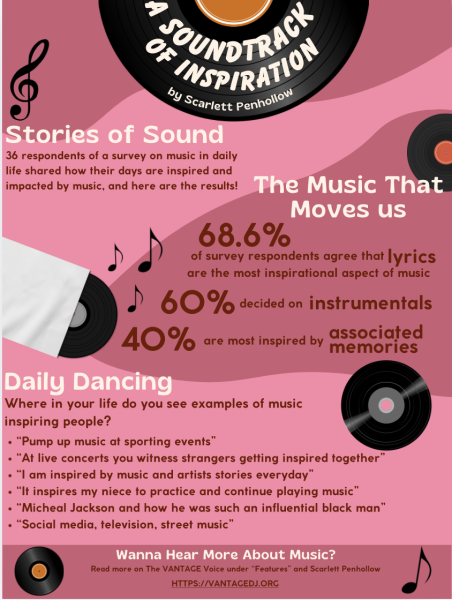
A Soundtrack of Inspiration Infographic