


How the Media has Portrayed Crime Over the Years
“We have a murdering monomaniac… who savagely mutilates as well as slays, who, further, is not apparently actuated by fanaticism”. These words are an encapsulation of the frenzy London became in the year 1888. This was when Jack the Ripper, one of the most notorious serial killers, was active. His savage methods of mutilating and murdering women plagued British society and tormented police. The killings became sensationalized by the press, and their exaggerated words spread fear throughout London. Though Jack the Ripper’s reign of terror was a period of fear and panic, journalists crafted their stories to entertain the public.
Though the press can be used as a tool to bring awareness to aspects of a case, there are many situations where it is used as entertainment for the public. That being said, there have also been stories where journalists have had a constructive effect on the litigation: the media can bring awareness and justice to certain elements of the investigation or trial.
The 1920s in America was a politically divisive time. Italian immigrants Nicola Sacco and Bartolomeo Vanzetti were convicted of robbery and murder in 1921 and executed via the electric chair in 1927. Both men were anarchists, and their ideologies led to polarizing opinions regarding the case. They had not had a fair trial, and this can be attributed to the anti immigrant sentiment that had spread throughout America. There was a bias against immigrants who supported communism, socialism, or anarchism, and their trial became a rallying point for many reform groups such as labor activists and human rights activists.
The press highlighted the prejudice within the criminal justice system and described the case as “anti-alien hysteria”. However, it was not just journalists who exposed the injustices in the criminal justice system but also artists. Poets, writers, and painters took it upon themselves to fight for the freedom of both men, creating artwork to express the unfairness of the case. “The Passion of Sacco and Vanzetti” was a famous series of paintings created by Ben Shahn that garnered lots of attention. The coverage led to international protests and demonstrations, inciting a closer look at how the US justice system treated immigrants differently.
Sacco and Vanzetti were symbols of the dangers surrounding how the Red Scare negatively affected immigrants and citizens with different ideologies. The coverage of their case, both artistic and literary, became a movement to protest how immigrants were being treated in America.
Lyle and Erik Menendez killed their parents, Mary Luis and José Menendez in 1989. It was a gruesome death as they had been shot fifteen times at close range. While the brothers were found to be guilty of the murders, there is still the question of who were the actual victims in the family.
This case was a discussion of morality. When someone is abused, does that give them the right to hurt their abusers? While there has been no official confirmation of their statements, Lyle and Erik have claimed that the murders were the result of years of sexual, physical, and emotional abuse.
The media played a vital role in portraying the Menendez brothers and affecting the public’s opinion of them. During the time of the trial, the press presented the brothers as greedy and violent, and it has only been recently that people have started to consider that the brothers were telling the truth about the abuse they had suffered from their parents.
Their trial was televised with more than 1.3 million people watching it. Court TV, a program that aired high profile court trials, involved journalists and legal analysts to discuss the case.
That being said, in the years following the case there have been SNL skits based on them, documentaries, and the show Monsters: the Lyle and Erik Menendez story. As a result, the Menendez brothers have publicly expressed disapproval of the show, criticizing the direction that the directors went in. Considering the intricacies of the case, including alleged sexual abuse, the media needs to consider the story they choose to tell. This is only one of many cases where there are two stories being told of the same person. One is of a monster, the other is of a victim, and the next case is yet another example of this indecisive media narrative.
“I’m afraid of having the mask of a murderer forced onto my skin”. Amanda Knox was a twenty year old American studying abroad in Italy in 2007. Her roommate, Meredith Kercher, was found dead in her bedroom, the victim of a violent and sex motivated murder. The fingerprints found in her room belonged to Rudy Guede, an Ivorian migrant, though by the time they had identified her real killer, Amanda Knox had become an international sensation.
Immediately, the police believed that Knox and her Italian boyfriend, Raffaele Sollecito were responsible for the murder. The media portrayed Knox as a sex-crazed and demonic murderer, as people suspected that the murder was a sex ritual gone fatally wrong.
European media told the story of a manipulative, provocative woman who killed her roommate. America chose to show the story of an innocent woman wrongfully convicted of a crime she did not commit. There was a media circus around the story which was a reflection of people’s differing perceptions of “provocative” women.
The case of Meredith Kercher revealed many cultural and societal divisions. Having been covered by the media internationally caused discordant reactions from the public.
Press coverage of criminal cases shares the process of portraying multiple stories being told of the people involved in the cases without filtering inaccuracies. People are sensationalized and the conflicting narratives being told will determine whether they earn the public’s empathy, hatred, or both.

(Siena Yusefzadeh)
60% of the True Crime Audience is Female: Here’s Why
Women account for the majority of the true crime industry audience. It seems contradictory as most victims are women, and most perpetrators are men. Why is it that women have such an obsession with hearing about gruesome and twisted stories?
- Morbid curiosity is one explanation some point to as an explanation for the deep fascination women have with true crime. This could be a part of it: humans can’t help but gravitate towards unpleasant things, especially death.
- According to an article written by Dr. Scott Bonn in Psychology Today, women are curious towards these cases because their empathy/morals prevent them from killing or hurting someone else. They can’t understand how someone could kill/ torture another, contributing to their compulsion to learn about the cases.
- Though a generalization, many argue that women are natural planners. When listening to/watching true crime, they take an analytical approach. How would they respond if placed in the same situation? It allows them to have responsibility and control over their life.
- From the same article, Bonn suggests that there is a connection that stems from the shared vulnerability of women. The fear that they might be a victim is what motivates them to hear the stories/cases. They also are empathetic and feel deeply for the other women who have suffered.
- Not only do women place themselves in the same situations or mindset of the victim, they also seek to understand the motive behind the perpetrator’s actions. If they are able to identify what behaviors to look out for or how they think, then they will be better prepared to protect themselves if in a dangerous situation. Understanding them is a survival instinct: they want to know what they are up against.
- Lastly, a BBC piece explains that women enjoy the puzzle behind unsolved true crime cases. They are able to untangle a story to try and dissect different aspects of it and hopefully be able to reach their own conclusions. They are thinkers- not to say that men aren’t- however becoming a part of the investigation is a form of entertainment.
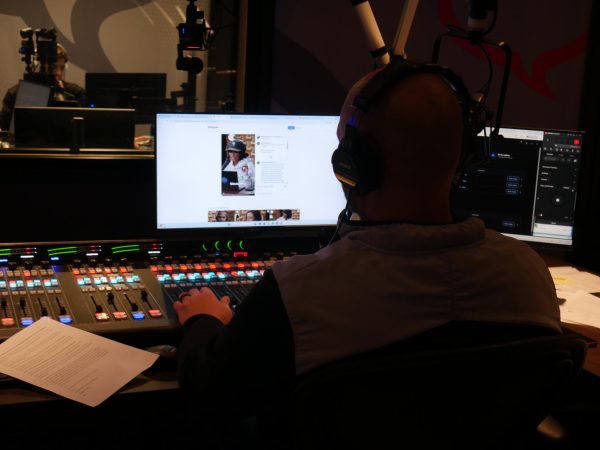
It is the producers job to make sure that the episode goes smoothly. While it seems like the hosts does the majority of the work, it would not be possible without the producers. (Siena Yusefzadeh)
3 Reasons Why Serial Killer Docudramas Could be Considered Unethical
Two thirds of adults in America enjoy watching shows and movies about serial killers. The idea that this genre of tv might be immoral often goes unrecognized. It may seem like a harmless form of entertainment, but the show’s portrayal of these stories impact the memory of the victim and lives of their family.
- Shows and movies tend to focus on the killers rather than their victims, thus shifting the attention away from the sufferers and their families, and focusing it on perpetrators. Instead of portraying the narrative of the victim and inciting empathy on the audience’s behalf, these series look at the story through the lens of the killers, often blaming childhood and society on their actions. This excuses their behaviors and the lives that they have taken by making it seem as though they are the ones who should garner sympathy.
- There are series based on/ pulled from real serial killers, though the casting can impact the audience’s perception of the killer. For example, Zac Efron plays the role of Ted Bundy in Extremely Wicked, Shockingly Evil and Vile. Casting like this romanticizes the killers, and allows people to focus less on what they did and more on what they look like. It can be challenging for the viewers to differentiate between the actor and their character.
- Creating shows and movies of these killers for mass consumption not only distracts the audience from the victim but also revictimizes the victim’s family. Not only do they have to grieve and learn to live with the aftermath of a killer’s fatal choices, it is turned into entertainment. Often produced and televised without consent from the victims’ families, these dramatized versions traumatize them. The common perspective in these depictions is telling the killer’s story to gain empathy, which invalidates the people’s deaths. It seems like these horrifying stories are used to make profit without consideration for those who are still grappling with their loss.

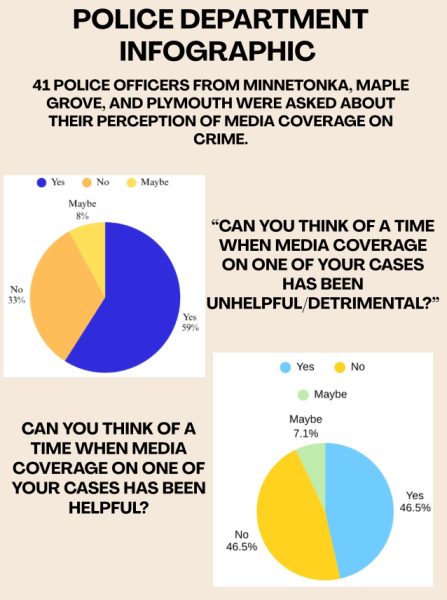
“It appears to me that the media is more interested in creating controversy than reporting on facts. Outlets want the views, clicks, and comments because viewership sells.” There is a clear division between the media and the police department, and some police claim that the media is only there to dramatize the stories.
(Siena Yusefzadeh)